REVIEW PROCESS
| Review Process |
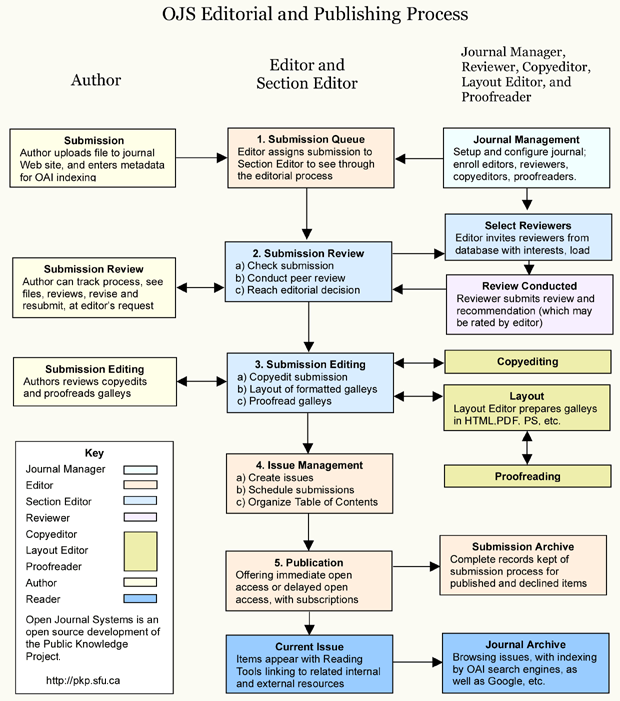
This journal uses Open Journal Systems 3.0.1.0, which is open source journal management and publishing software developed, supported, and freely distributed by the Public Knowledge Project under the GNU General Public License.
Peer Review and Editorial Process
All submissions to QUAERENS: Journal of Theology and Christianity Studies undergo a rigorous double-blind peer-review process to ensure the quality, originality, and scholarly integrity of the published research. Under this process, both the authors and the reviewers remain anonymous throughout the review process. Manuscripts are evaluated by independent experts in the relevant fields based on their scientific merit, originality, methodological rigor, and relevance to the journal's aims and scope.
-
Initial Evaluation:
Upon receipt of a manuscript, the editorial board will conduct an initial evaluation to ensure that the manuscript aligns with the journal's scope and adheres to the publication conditions. Manuscripts that do not meet these requirements or exhibit more than 30% similarity will be rejected at this stage. The editorial office will also check the article formatting, citation styles, and adherence to the author guidelines. If the required conditions are unmet, the manuscript will be returned to the author for reformatting and resubmission. Manuscripts that pass this evaluation will be sent to reviewers. -
Assignment of Reviewers:
The editorial board will select independent reviewers who are experts in the relevant field of theology and ministry. The reviewers will evaluate the manuscript while being blinded to the identity of the authors, and the authors will also remain unaware of the reviewers' identities. The names of the authors, acknowledgments, and references to author contributions must be removed from the manuscript and listed on a separate title page file. The assigned editor will send invitations to reviewers, who are expected to be from institutions different from those of the corresponding authors. Reviewers will consider the invitation based on their scientific expertise, potential conflicts of interest, and other relevant criteria. Our journal is committed to assigning reviewers within two weeks. -
Review Process:
Reviewers will evaluate the manuscript based on its scientific quality, originality, validity, and relevance to the field of theology and Christianity. The reviewers are usually given two weeks to complete their review. They will provide constructive feedback to the authors to help improve the manuscript and may recommend acceptance, rejection, or revision of the manuscript. -
Decision:
The editor-in-chief and the editorial team will make the final decision regarding the acceptance, rejection, or revision of the manuscript based on the feedback provided by the reviewers and the manuscript’s adherence to the publication conditions. If the reviewers’ comments differ significantly, the academic editor may invite an additional reviewer to evaluate the manuscript. The academic editor will send a decision (acceptance, rejection, or request for major or minor revisions) to the author via the online system, along with the reviewers' anonymous comments. The average time from submission to the first decision is approximately one month, and the time from acceptance to publication is typically 2-4 weeks. -
Revision Process:
If the manuscript is accepted with revisions, the authors will be required to revise the manuscript based on the reviewers' feedback and resubmit it for further review. Authors are typically given two weeks for minor revisions and four weeks for major revisions. The revised manuscript should include a highlighted version with the changes and a rebuttal letter. For major revisions, the manuscript will undergo a second round of review by the same reviewers, who will evaluate whether the revisions adequately address their feedback. For minor revisions, a subsequent review may not be necessary. -
Publication:
Once the manuscript has been accepted for publication, the authors will be asked to submit the final version of the manuscript, which will be copyedited and formatted for publication in the journal.
This peer-review process ensures that all manuscripts submitted to QUAERENS are evaluated based on the highest standards of scholarly integrity and ethical conduct, and that only high-quality research is published.
Publication Ethics and Publication Malpractice Statement for Peer Review Process
QUAERENS is committed to upholding the highest standards of publication ethics and preventing publication malpractice in its peer-review process. We adhere to the following guidelines:
-
Confidentiality:
The peer-review process is confidential. All information related to submitted manuscripts must be kept confidential by the editors, reviewers, and any other involved parties. Manuscripts or their details should not be disclosed to unauthorized individuals. -
Objectivity and Impartiality:
Peer reviews should be conducted impartially, without personal bias or conflicts of interest. Editors and reviewers will evaluate manuscripts based on scientific merit, relevance, and quality, providing constructive feedback to authors to improve their work. -
Timeliness:
QUAERENS is committed to a timely peer-review process. Editors and reviewers are expected to complete their reviews within a reasonable timeframe. Authors will be promptly informed about the status and progress of their manuscripts. -
Transparency and Accountability:
The peer-review process should be transparent and accountable. Reviewers are encouraged to provide clear, well-reasoned, and constructive feedback. Editors should make fair decisions based on the reviewers’ comments and their own expertise. -
Conflict of Interest:
Editors and reviewers must disclose any potential conflicts of interest that may affect their impartiality in the review process. If a conflict of interest arises, appropriate actions will be taken to ensure unbiased evaluation. -
Plagiarism and Misconduct:
Editors and reviewers are responsible for identifying any potential cases of plagiarism, data fabrication, or other forms of misconduct. Any suspected misconduct will be promptly reported to the relevant authorities. -
Peer Reviewer Recognition:
QUAERENS acknowledges the vital role of peer reviewers in maintaining the integrity of the journal and will provide appropriate recognition and credit to reviewers for their valuable contributions.
QUAERENS is committed to ensuring that the peer-review process is fair, transparent, and adheres to the highest standards of scholarly integrity, thereby upholding the quality and credibility of the research published in the journal.