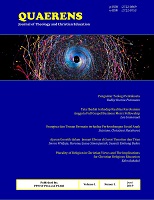
PLURALITY OF RELIGION IN CHRISTIAN VIEWS AND THE IMPLICATIONS FOR CHRISTIAN RELIGIOUS EDUCATION
DOI:
https://doi.org/10.46362/quaerens.v1i1.23Keywords:
plurality, religion, christian religious educationAbstract
This article aims to describe the plurality of religions in the Christian view and how they are implicated in Christian Religious Education. The method used is quantitative description, where the authors collect material from various sources of writing that relate to religious plurality and Christian views view it. The result of this writing is the discovery of the first theocentric approach, namely religions that exist in a shared environment and life that all come from one common root or ancestor, and from the same God. Second, christocentric, which prioritizes the discussion of the relationship of Christianity with plurality or other religions by highlighting Jesus as a measure. The implication is first the curriculum and specifically the material or teaching material needs to be adapted to the context. Second, the speakers as resource persons, whoever they are, who are involved in the teaching of PAK, need to have at least adequate knowledge, insights and skills about the condition of plural religious communities and pluralism into general principles and characters.
Downloads
Downloads
Published
Issue
Section
License
Authors who publish with this journal agree to the following terms:
- Authors retain copyright and grant the journal right of first publication with the work simultaneously licensed under a Creative Commons Attribution License that allows others to share the work with an acknowledgement of the work's authorship and initial publication in this journal.
- Authors are able to enter into separate, additional contractual arrangements for the non-exclusive distribution of the journal's published version of the work (e.g., post it to an institutional repository or publish it in a book), with an acknowledgement of its initial publication in this journal.
- Authors are permitted and encouraged to post their work online (e.g., in institutional repositories or on their website) prior to and during the submission process, as it can lead to productive exchanges, as well as earlier and greater citation of published work (See The Effect of Open Access).